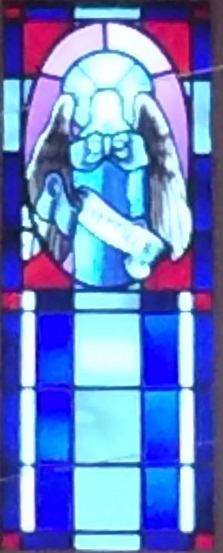
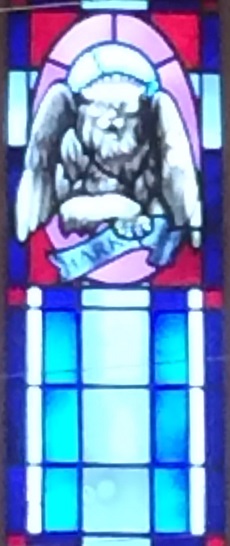
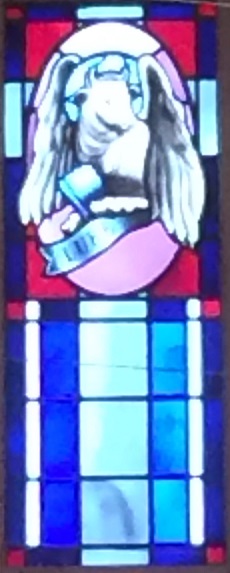
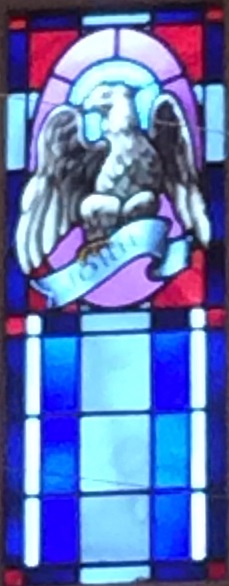
"If churches are made radiant and beautiful places of worship, we can have a spiritual regeneration without anyone knowing what is going on. Beauty can preach as very few men with bundles of words can preach. I want to make beautiful interiors for both churches and souls. I want men to hear my windows singing; to hear them singing of God; I want men to know that God is at the core of their own souls."These words, written in 1931 by Charles J. Connick of Chicago, creator of some of our nation's finest stained-glass windows, express the continuing desire of the membership of First Baptist Church. Great care and attention were given to historic and symbolic considerations when our present sanctuary was built in 1955-1957. The "sermon" declared by the building itself is interpreted here for this and coming generations with the hope that yesterday's labors might be today's and tomorrow's cherished legacy.
One significant alteration from pure Georgian Colonial style is visible in our church's crucifix perimeter, the walls themselves enclosing the congregation within a cross. This cruciform pattern for places of Christian worship dates back at least to 326 A.D. when Old St. Peter's Basilica, the precursor to the present St. Peter's and the Vatican, was planned in Rome. Therefore, features of our sanctuary declare a continuity with Christ's church from ancient times, and from Roman Catholic and Anglican (Protestant) traditions.
The interior spaces of the sanctuary are worthy of note. The ancient basilica pattern provided entrance to the sanctuary through a courtyard, often with an atrium, and then a foyer or narthex area. Entering the sanctuary itself, the worshiper processed up the central long area, known as the nave, and approached the altar area, or chancel or apse as it was called. This focal point at the front of the sanctuary was usually framed in a high vaulted arch, the dome of which was resplendent with angelic scenes. Thus, as the worshiper came from the narthex to the chancel area in the communion procession he or she was symbolically transported through the nave (a Latin word meaning "ship" and then, in Christian symbolism, the "church"), through the arch of triumph to the haven, or heaven, of salvation reflected in the celestial scenes decorating the ceiling of the apse or chancel area. Of course, the processional itself, had to pass through the center of the cruciform pattern of the sanctuary with the arms of the cross (an area called the transept) surrounding the worshipers. Hence the entire structure of architecture and of worship proclaimed the centrality of the cross of Jesus in man's salvation.
Another architectural peculiarity of the sanctuary is the divided chancel, the pulpit and the lectern placed to the right and left. Within the Free Church (Baptist) tradition the pulpit is more frequently found in the center, underscoring the centrality of preaching within that tradition. However, this church chose, in its previous sanctuary built in 1891 and in the current one, to follow the more ancient practice of a divided chancel with the communion table occupying the central place. Thus, for almost a century, the church has displayed through its buildings an ecumenical spirit while maintaining its Baptist identity.
| | | |
The chancel area therefore provides a unified testimony to the person and work of Christ as presented in the Gospels, and of man's need to trust him and follow him, believer's baptism being a primary expression of this whereby we discover the haven of the church and the power of the Holy Spirit.
| Beginning in the east transept of the sanctuary and proceeding to the narthex, the eastern windows depict the following themes: | |
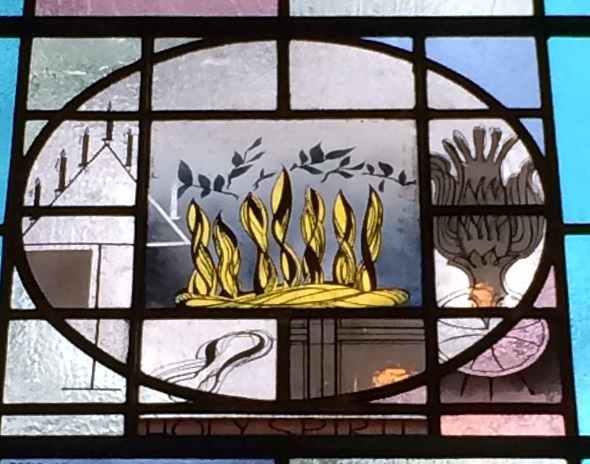 | Holy Spirit--The seven gifts of the Holy Spirit--power, riches, wisdom, strength, honor, glory, and blessing bestowed on Christ--are represented in the seven candles. The descending dove and the flame symbolize the coming of the Spirit upon Jesus at his baptism and upon the Church at Pentecost. |
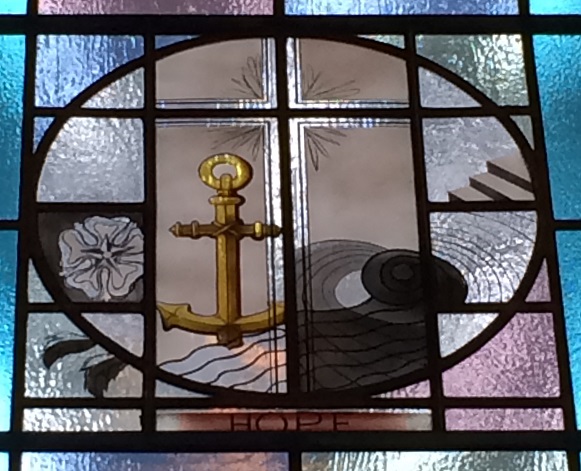 | Hope--The anchor cross represents the well grounded hope of the church as it follows an often dark and winding path (as symbolized by the circling, dark patterns on the lower right) and ascends the steps (above right) of faith, hope and love. Isaiah's prophecy of the desert blossoming as a rose is the basis for the bright rose of hope also depicted. |
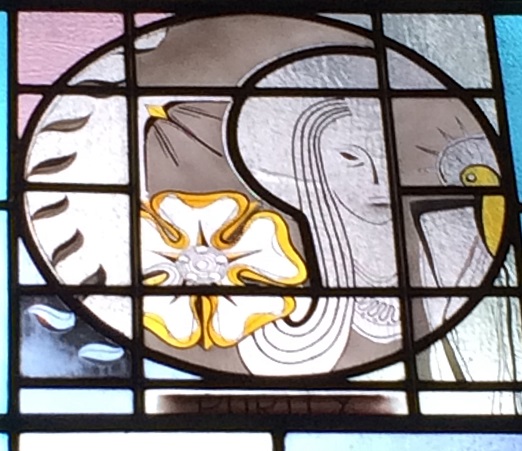 | Purity--The symbols of the Virgin Mary, the rose and the dove interpret this theme as a call to holy living. |
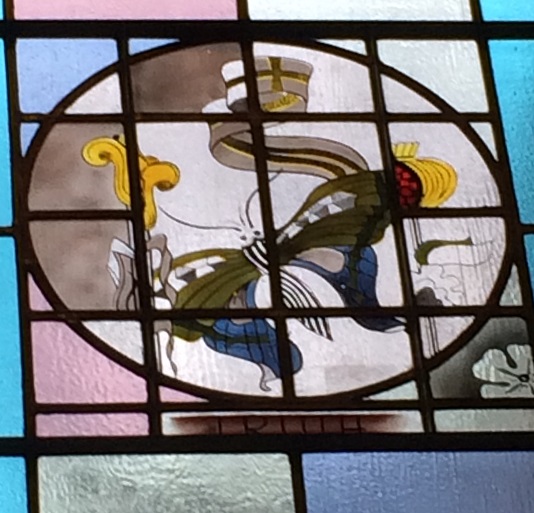 | Truth--The brilliant butterfly crafted here is often used as a symbol of resurrection and eternal life because of its life cycle from caterpillar to cocoon to butterfly. Here, however, it speaks of the unfolding nature of truth, especially of "the truth as it is in Christ Jesus" which, though often denigrated as ugly and impotent, rises to be the heights of the wisdom of God. |
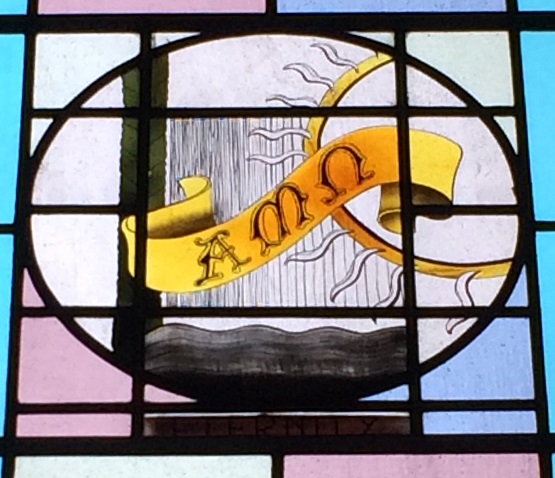 | Eternity--The primal elements of sun, sky and dark brooding waters reflect the creation account of Genesis while the emblazoned Greek letters of Alpha, Mu and Omega (the first, middle, and last letters of the alphabet) proclaim the eternality of Jesus Christ, "the same yesterday, today and forever." |
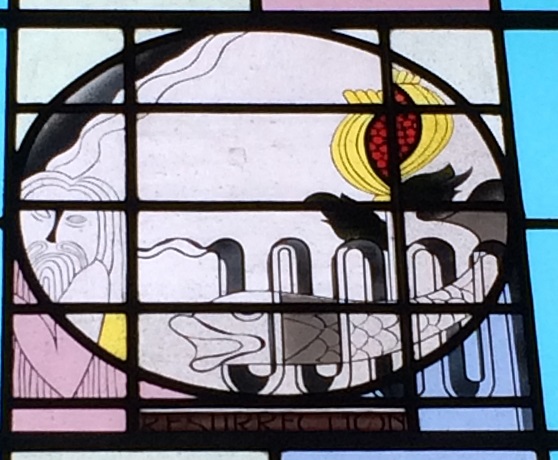 | Resurrection--The bursting pomegranate was an ancient Christian symbol of the resurrection. The fish and the water and the man's face recall Jesus' prophecy: "Even as Jonah was in the belly of the whale for three days, so shall the Son of Man be...in the heart of the earth." Matthew 12:40 |
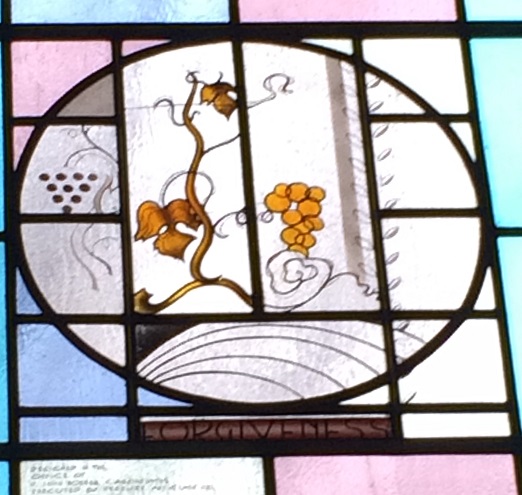 | Forgiveness--The vine is an expression of the relationship between God and His people Israel. Jesus uses the imagery in John 15 to speak of his followers as branches of his, the true vine. They have been pruned, cleansed by him for fruitful discipleship. |
| Walking across the nave of the sanctuary, we continue by examining the windows on the western wall from the narthex up through the transept. | |
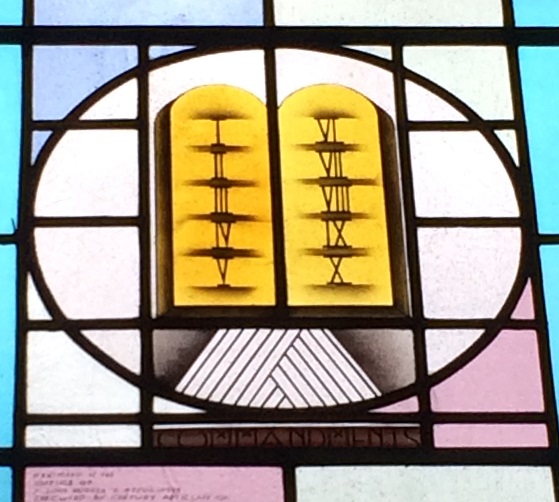 | Commandments--The stark simplicity of this depiction of the Mosaic stone tablets with their ten commandments preserves the austerity and bluntness of the commandments themselves. |
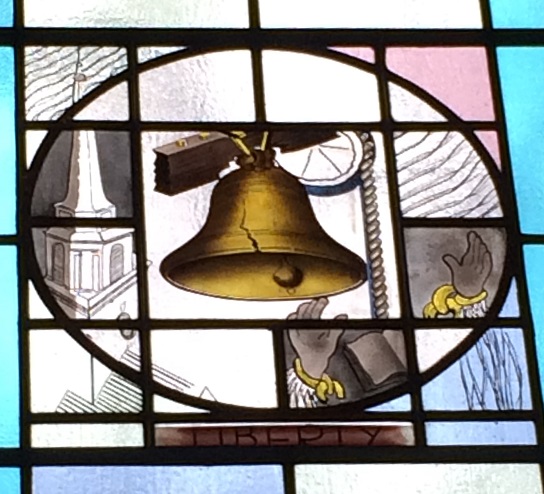 | Liberty--Engraved upon our nation's Liberty Bell, which is dominant in this window, are the words "Proclaim liberty throughout the land," a phrase from Leviticus 25:10. The freedom of mankind, politically and spiritually, is found not just in the breaking of binding chains but by faith and knowledge, represented here by the church and an open book. |
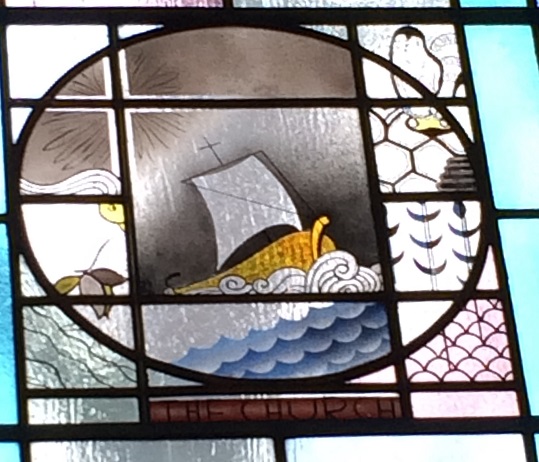 | The Church--The symbol of the ship (discussed above) also came in later days to represent the church's world-wide missionary charge. The church is haven (ark), journey and expedition according to this symbol. The bee and honeycomb call the church to diligence, work and good order while the grain of wheat falling to the ground reminds the church that it lives by dying. |
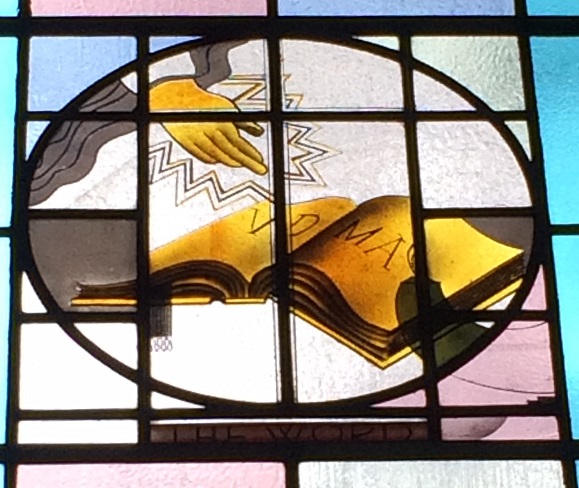 | The Word--The hand of God is represented as giving the word while the letters V.D.M.A. represent the Latin phrase Verbum Dei Manet Aeternum meaning "the Word of God remains forever." (These letters are also carved into the front of our pulpit but are usually covered by the cloth parament hanging from the top of the pulpit.) The lamp in the lower right hand recalls the psalmist's testimony: "Thy word is a lamp unto my feet and a light unto my path." |
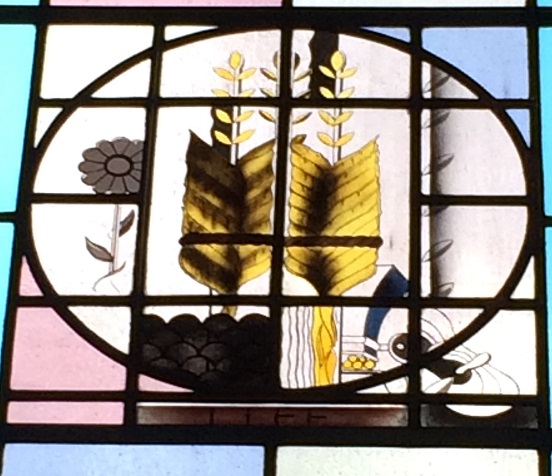 | Life--This window follows the method of Jesus in using phenomena of nature to teach spiritual truth. Wheat rises from the earth and is harvested and taken to the mill and formed into the Bread of Life as represented in the lower right-hand portion of the window. The sunflower at the left represents the soul turning to Christ, symbolized further in the characteristic of the sunflower always turning toward the sun as man must turn to God for power and sustenance. |
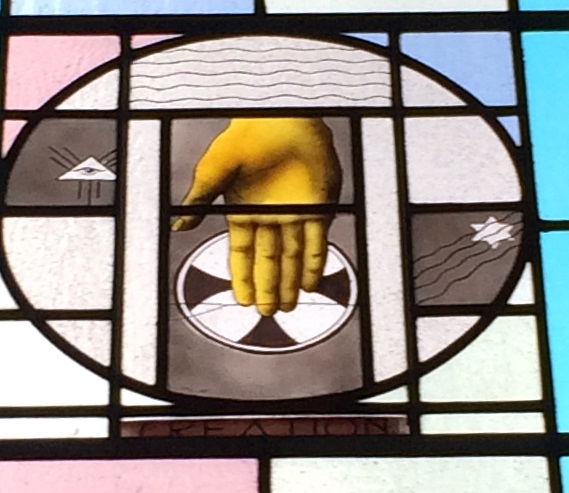 | Creation--"And darkness was upon the face of the deep; and the Spirit of God was moving over the face of the waters." These words from Genesis are interpreted here by the symbols of the Creator's star and the hand and eye of an all-seeing trinitarian God moving over the waves and water. |
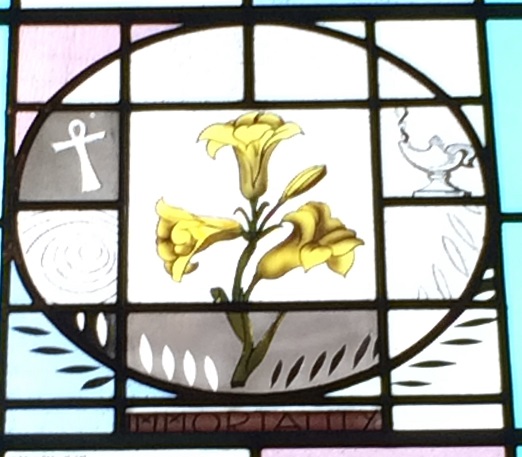 | Immortality--Symbols of immortality (the infinity of the spiral) and of resurrection (the anchor cross and Easter Lily) are utilized here to declare the church's lamp of life and light in the darkness of death. |
To those who will listen the building itself preaches a profoundly Christian sermon to the glory of God.
May, 1987